The Kansas City
Missouri Police Department will honor its 119 officers killed in the line of
duty throughout the department’s history with a Memorial Service beginning at
10 a.m. Thursday, May 23. Due to renovations at Headquarters, this year’s
service will be at a new venue, Kansas City Regional Police Academy’s Sports
Field located at 6885 NE Pleasant Valley Rd., Kansas City, MO. We may be in a different place, with a newer and
different look, on this year’s day of remembrance, but the sacrifices of those
who died serving our community are with us everywhere.
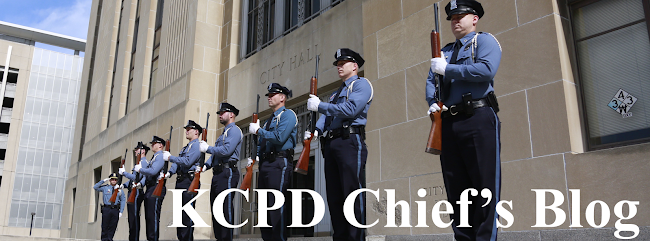
The service will include an honor guard, a
21-gun salute, the KCPD Color Guard, bagpipers, a flyover by the police
helicopter, and a riderless horse. Supervisor L.C. Clark will read the names of
all KCPD officers killed in the line of duty – the first in 1881 and the last
in 2001. There will be 119 flags on display representing each one of these
officers. For 119 hours preceding the service, dispatchers read one officer’s
name per hour over the police radio system. The last officer’s name, Craig
Schultz, will be read immediately before the ceremony begins Thursday.
In the event of rain, the ceremony will take
place inside the gymnasium of the Academy.
I encourage everyone to attend the ceremony and for all to keep in mind
the sacrifices our officers make to keep our community safe. Their commitment to excellence is our
community’s benefit.
Send Comments to kcpdchiefblog@kcpd.org
Tuesday, May 21, 2013
Monday, May 20, 2013
Click It or Ticket
Press Release:
Kansas City , Missouri
– The Kansas City ,
Missouri Police Department will begin enforcing the City’s new primary seat
belt ordinance today the first day of the two-week nationwide
“Click It or Ticket” campaign. The ordinance
passed the City Council in early April and the department has been conducting a
public information campaign since then to make citizens aware of the change. This week, officers will be handing out
informational pamphlets to motorists at major intersections around the city and
to those that are stopped for traffic violations.
The new primary ordinance will allow police officers to stop a vehicle solely for lack of seat belt use by the driver or any front-seat passenger. Before, another violation was needed to be able to enforce the secondary ordinance. The new fine for a seat belt violation is $50.00, up from the previous $10.00.
“This is the perfect time for this new ordinance to go into effect,” said Sgt. Grant Ruark of the Traffic Division. “We believe this will make a significant difference in our ability to raise the seat belt usage rate in our city. Our rate of 79% is well below the national average of 86% and with nearly seven out of ten victims of fatality accidents in a passenger vehicle being unbuckled, something had to be done. We hope that our citizens will buckle up and “Arrive Alive.”
Traffic officers will be conducting overtime enforcement in addition to their regular duties during the “Click It or Ticket” mobilization which ends June 2nd.
For more information onMissouri seat belt
usage, visit www.saveMolives.com
Send Comments to kcpdchiefblog@kcpd.org
The new primary ordinance will allow police officers to stop a vehicle solely for lack of seat belt use by the driver or any front-seat passenger. Before, another violation was needed to be able to enforce the secondary ordinance. The new fine for a seat belt violation is $50.00, up from the previous $10.00.
“This is the perfect time for this new ordinance to go into effect,” said Sgt. Grant Ruark of the Traffic Division. “We believe this will make a significant difference in our ability to raise the seat belt usage rate in our city. Our rate of 79% is well below the national average of 86% and with nearly seven out of ten victims of fatality accidents in a passenger vehicle being unbuckled, something had to be done. We hope that our citizens will buckle up and “Arrive Alive.”
Traffic officers will be conducting overtime enforcement in addition to their regular duties during the “Click It or Ticket” mobilization which ends June 2nd.
For more information on
Send Comments to kcpdchiefblog@kcpd.org
Friday, May 3, 2013
Cops and Kids Working Together
The Police Athletic League (PAL)
is a non-profit organization, staffed by KCPD officers, that offers athletic
and academic programs to about 700 urban-core children. The center experienced
its most generous year of donations ever, allowing it to upgrade facilities and
provide more programs for inner-city youth.
We recently celebrated our Grand
Re-Opening of the PAL Center located at 1801 White Avenue on May 1. At the
ceremony we were able to showcase the new NFL Chief’s football field with a
ribbon cutting, presentation of awards to major donors and honoring the PAL
board members. Among those recognized were Curry Real Estate Services,
Messengers Lawn and Landscapes, Paul Davis Restoration, United Heating &
Cooling, Mark One Electric, The American Fence Association Midwest Chapter and
PAL Board Members Nancy Simons, Jim Carr, Larry Washington, Mike Carter, Cindy
Mason and Web Bixby.
The donations
resulted in a new air conditioner and duct work, partial new roof, landscaping,
lighting for new athletic fields, storage sheds and more. More than 50 local businesses
supported PAL in 2012 through $750,000 in donations, about a third of
those were in-kind. Many
came through Christine Lentz of Curry Property Management.
All of the donations
have led to a better PAL Center, which is more than 50 years old, and programs
that attract more youth. Those youth, in turn, focus their time and energy on
something positive to develop critical life and leadership skills instead of
becoming involved in criminal activity. The positive relationships they develop
can be attributed to both the generous donors and the dedication of the
officers involved.
PAL hosted the
Upper Room Summer Academic Program for the second year, which helped 180
children come to read at grade level. The program also provides them food,
something many don’t get as much of during the summer when schools and their
lunch programs are out of session. PAL introduced sewing and gardening programs
in 2012 to appeal to more youth, which have drawn great interest. A 7th/8th
grade football team also took the field for the first time.
This year will be
the first time the PAL Center will be a host site for Harvesters, the Community
Food Network, which will serve approximately 300 people. I want to thank all
those involved in making the PAL Center what it is today. We hope to continue
to explore innovative and exciting avenues to keep Cops and Kids Working
Together.
Send comments to kcpdchiefblog@kcpd.org
Wednesday, April 17, 2013
Remaining vigilant in Kansas City
In light of the tragic terrorist attack in Boston, many have asked what we’re doing to ensure security in Kansas City. The answer to that question is, “a lot.” While we have taken additional measures since the Boston bombings, a good deal of what we do is an ongoing and constant vigilance at the local, state and federal level that has been in place for years. This vigilance has led to the disruption of terrorist training and funding going on right here in Kansas City and has been part of every major event we plan for in the community.
In regard to the Boston attack specifically, our Homeland Security Unit and the Kansas City Terrorism Early Warning Center – a regional team of analysts – are searching numerous sources for any indication of if, where and when something may happen, not just in Kansas City proper but across the metropolitan area. They are staying in constant contact with the U.S. Department of Homeland Security, FBI and other governmental partners to obtain the latest information. We have received no credible threats for our area at this time.
We are constantly preparing for emergency response to natural or manmade incidents. The Major League Baseball All-Star Game was a prime example. About this time last year, we conducted a full-scale exercise with federal, state and local agencies that involved hundreds of players responding to a mock explosion with civilian casualties at Kauffman Stadium. That helped us further refine our emergency operations plan for the All-Star Game as well as our critical incident manual, which is updated regularly. We work with all city agencies at the Emergency Operations Center and exercise our capabilities on at least an annual basis. We have resources like a new fleet of helicopters, a mobile command post and a mobile communications trailer for incident management in Kansas City and throughout the region.
No one should be afraid to carry on with their normal activities. Run the race you planned to. Go to sporting events; enjoy concerts, shopping, dining and more. While it’s important that everyone carry on as normally as possible, we do ask that you remain aware of what’s going on around you. This is the case for regular crime as well as terrorist activities. If you see something suspicious, report it to law enforcement. The KC Terrorism Early Warning Center has some good guidelines on what could constitutes suspicious terrorist activity.
Send comments to kcpdchiefblog@kcpd.org
In regard to the Boston attack specifically, our Homeland Security Unit and the Kansas City Terrorism Early Warning Center – a regional team of analysts – are searching numerous sources for any indication of if, where and when something may happen, not just in Kansas City proper but across the metropolitan area. They are staying in constant contact with the U.S. Department of Homeland Security, FBI and other governmental partners to obtain the latest information. We have received no credible threats for our area at this time.
We are constantly preparing for emergency response to natural or manmade incidents. The Major League Baseball All-Star Game was a prime example. About this time last year, we conducted a full-scale exercise with federal, state and local agencies that involved hundreds of players responding to a mock explosion with civilian casualties at Kauffman Stadium. That helped us further refine our emergency operations plan for the All-Star Game as well as our critical incident manual, which is updated regularly. We work with all city agencies at the Emergency Operations Center and exercise our capabilities on at least an annual basis. We have resources like a new fleet of helicopters, a mobile command post and a mobile communications trailer for incident management in Kansas City and throughout the region.
No one should be afraid to carry on with their normal activities. Run the race you planned to. Go to sporting events; enjoy concerts, shopping, dining and more. While it’s important that everyone carry on as normally as possible, we do ask that you remain aware of what’s going on around you. This is the case for regular crime as well as terrorist activities. If you see something suspicious, report it to law enforcement. The KC Terrorism Early Warning Center has some good guidelines on what could constitutes suspicious terrorist activity.
Send comments to kcpdchiefblog@kcpd.org
Tuesday, April 9, 2013
Mediation Center provides vital service
Do you know what the No. 1 known motive for murder is in Kansas City? It’s not drugs, gangs or domestic violence. It’s arguments. Last year, 22 people were killed because they were involved in a dispute with someone who could not resolve the conflict without violence.
This deadly shortage of conflict resolution and anger management skills can be remedied. We have a great resource locally in the non-profit Community Mediation Center. Our police officers sometimes refer individuals involved in ongoing conflicts to the Center – usually neighbors with issues and landlords/tenants.
The Center’s goal is to give people the skills to deal with conflict at lower levels so it doesn’t escalate into violence. In addition to police, they also get referrals from places like schools, churches, the court and the City’s Aim 4 Peace program.
When the City’s mediation services were cut from the budget four years ago, the Community Mediation Center picked up the slack. They served 5,942 people in 2012, 61 percent of whom were from Kansas City, Mo. They do a lot of valuable work in this community without a lot of resources, so I’d encourage those who are interested to consider volunteering or supporting them in other ways. More information about how to do so is on their web site.
The Center also provides training to everyone from students to business professionals. I even plan to take their interpersonal conflict resolution training to make me more effective at my job.
Many people have called for ways to reduce violence in our city. Giving people the tools to resolve conflict is a major one that doesn’t get the attention it should. I’m glad organizations like the Community Mediation Center are there to step in the gap.
Send comments to kcpdchiefblog@kcpd.org.
This deadly shortage of conflict resolution and anger management skills can be remedied. We have a great resource locally in the non-profit Community Mediation Center. Our police officers sometimes refer individuals involved in ongoing conflicts to the Center – usually neighbors with issues and landlords/tenants.
The Center’s goal is to give people the skills to deal with conflict at lower levels so it doesn’t escalate into violence. In addition to police, they also get referrals from places like schools, churches, the court and the City’s Aim 4 Peace program.
When the City’s mediation services were cut from the budget four years ago, the Community Mediation Center picked up the slack. They served 5,942 people in 2012, 61 percent of whom were from Kansas City, Mo. They do a lot of valuable work in this community without a lot of resources, so I’d encourage those who are interested to consider volunteering or supporting them in other ways. More information about how to do so is on their web site.
The Center also provides training to everyone from students to business professionals. I even plan to take their interpersonal conflict resolution training to make me more effective at my job.
Many people have called for ways to reduce violence in our city. Giving people the tools to resolve conflict is a major one that doesn’t get the attention it should. I’m glad organizations like the Community Mediation Center are there to step in the gap.
Send comments to kcpdchiefblog@kcpd.org.
Thursday, April 4, 2013
Our department's new mission statement
We recently updated our department’s mission statement, and I wanted to share it with you and explain the change. This is the new statement:
To protect and serve with professionalism, honor and integrity.
Simply put, the mission statement is why we exist. It is a summary of what our daily practices should reflect as well as serve as a reminder of why we have chosen a career in law enforcement. Clarity and brevity are crucial components of the mission statement. However, of most importance is adherence to what the statement says.
We must consistently exhibit a servant-based attitude – an eagerness to speak for those who cannot speak for themselves. Our department members also must continue to develop so we can contribute to reducing crime in Kansas City.
Our purpose must be clearly understood by all department members and communicated to other segments of the community, and I hope this new statement does that.
We are proud and honored to serve such an engaged community. Your continued support is needed and truly appreciated.
Send comments to kcpdchiefblog@kcpd.org.
To protect and serve with professionalism, honor and integrity.
Simply put, the mission statement is why we exist. It is a summary of what our daily practices should reflect as well as serve as a reminder of why we have chosen a career in law enforcement. Clarity and brevity are crucial components of the mission statement. However, of most importance is adherence to what the statement says.
We must consistently exhibit a servant-based attitude – an eagerness to speak for those who cannot speak for themselves. Our department members also must continue to develop so we can contribute to reducing crime in Kansas City.
Our purpose must be clearly understood by all department members and communicated to other segments of the community, and I hope this new statement does that.
We are proud and honored to serve such an engaged community. Your continued support is needed and truly appreciated.
Send comments to kcpdchiefblog@kcpd.org.
Thursday, March 28, 2013
As snow melts, hard work of Building Operations staff comes to forefront
The last of the snow from the city’s latest storm is melting today, and it reminds me to point out the hard work of those who were behind the scenes ensuring the work of police could continue during each of these weather events.
Our Buildings Operations personnel quietly maintain our facilities so employees can do their jobs of public safety. It’s not an easy task. Some of our buildings – like Headquarters, built in 1938 – are old and have continuous problems (thanks to the public safety sales tax, we are working to address these issues, but it will take time). The Building Operations staff members work so smoothly we often don’t think about all they do. In the three major snow events in the last month and a half, however, the importance of their work became very evident.
Unlike businesses and other government operations, the police department can’t shut down during inclement weather. In fact, that’s often when officers are needed most – helping stranded motorists and those involved in car crashes. But they would never be able to assist the public if they were snowed in at police stations. And they couldn’t have left the stations without all our Building Operations personnel did.
During each of our three big snow events, Building Ops crews logged about 160 man-hours of snow removal duty at our patrol division stations, Headquarters, Fleet Operations Unit, Helicopter Section and other critical facilities. That’s 480 total hours dealing with the snow. During each event, crews plowed; spread about 20 tons of salt; and two tons of ice melt. Personnel from Patrol, Fleet and Helicopter also came out to help. Their primary goal was to keep the patrol stations operational, then plow and salt all secondary lots.
As the reminder of their hard work melts away, I just wanted to take this opportunity to thank the members of our Building Operations Unit for all their hard work.
Send comments to kcpdchiefblog@kcpd.org.
Our Buildings Operations personnel quietly maintain our facilities so employees can do their jobs of public safety. It’s not an easy task. Some of our buildings – like Headquarters, built in 1938 – are old and have continuous problems (thanks to the public safety sales tax, we are working to address these issues, but it will take time). The Building Operations staff members work so smoothly we often don’t think about all they do. In the three major snow events in the last month and a half, however, the importance of their work became very evident.
Unlike businesses and other government operations, the police department can’t shut down during inclement weather. In fact, that’s often when officers are needed most – helping stranded motorists and those involved in car crashes. But they would never be able to assist the public if they were snowed in at police stations. And they couldn’t have left the stations without all our Building Operations personnel did.
During each of our three big snow events, Building Ops crews logged about 160 man-hours of snow removal duty at our patrol division stations, Headquarters, Fleet Operations Unit, Helicopter Section and other critical facilities. That’s 480 total hours dealing with the snow. During each event, crews plowed; spread about 20 tons of salt; and two tons of ice melt. Personnel from Patrol, Fleet and Helicopter also came out to help. Their primary goal was to keep the patrol stations operational, then plow and salt all secondary lots.
As the reminder of their hard work melts away, I just wanted to take this opportunity to thank the members of our Building Operations Unit for all their hard work.
Send comments to kcpdchiefblog@kcpd.org.
Tuesday, March 19, 2013
Keeping officer-involved shootings at a minimum
Our mission at the Kansas City Missouri Police Department is, “To protect and serve with professionalism, honor and integrity.” To me, part of that means doing everything we can to protect human life. Officers here do that every day, from stopping drunk drivers who could kill someone on a roadway to helping domestic violence victims get away from their abusers.
But once in a while, officers are forced to take a life or injure someone to protect themselves or others. Ask any officer who has been involved in such a situation, and he or she likely will count it as the worst moment of their career. Kansas City officers have been involved in one such shooting already this year when on Jan. 15, a man who eluded police in Independence stopped for Kansas City police on I-435 near Front Street. He got out of his vehicle and started shooting at officers. They returned fire, killing him. A grand jury ruled the officers committed no crimes.
One of my goals as Chief of Police is to keep officer-involved shootings as low as possible. That’s why I recently asked investigators to prepare a report outlining every officer-involved shooting at KCPD for the last 10 years to see whether there were any patterns we should be on the lookout for. The shootings in this report included those that resulted in fatalities, those that didn’t, and those in which no one even was hit. I was relieved to see the numbers are relatively low, and there is no discernible pattern. Some of the findings:
From 2002 to 2012, KCPD had 132 officer-involved shootings. Of those:
• 47 resulted in a suspect fatality.
• Another 47 resulted in a suspect sustaining serious physical injury but surviving.
• 11 resulted in an officer sustaining a physical injury. One had to retire for medical reasons as a result, and two others continue to recuperate.
• Officer-involved shootings were most like to occur during armed subject and shots fired calls.
We also have made a strong effort to avoid officer-involved shooting situations with the mentally ill. One-fourth of our patrol officers are Crisis Intervention Team (CIT)-certified, meaning they have undergone extensive training in how to handle someone who is mentally ill and in crisis. Police are usually the first to respond to such an incident. Sergeants also are now required to respond to all CIT calls.
We have an array of less-than-lethal options that our officers use to protect themselves and others, everything from Tasers to beanbag shotguns. They have shown great discretion over the years in knowing when to use these to bring about the best resolution for everyone involved.
An officer usually has only seconds to make life or death decisions. An article in our recent Informant newsletter discusses how we educate grand juries about the situations in which officers find themselves. Police face the heavy burden every day of knowing they might have to make such a choice, and I appreciate the seriousness and professionalism with which KCPD members take that responsibility.
Send comments to kcpdchiefblog@kcpd.org.
But once in a while, officers are forced to take a life or injure someone to protect themselves or others. Ask any officer who has been involved in such a situation, and he or she likely will count it as the worst moment of their career. Kansas City officers have been involved in one such shooting already this year when on Jan. 15, a man who eluded police in Independence stopped for Kansas City police on I-435 near Front Street. He got out of his vehicle and started shooting at officers. They returned fire, killing him. A grand jury ruled the officers committed no crimes.
One of my goals as Chief of Police is to keep officer-involved shootings as low as possible. That’s why I recently asked investigators to prepare a report outlining every officer-involved shooting at KCPD for the last 10 years to see whether there were any patterns we should be on the lookout for. The shootings in this report included those that resulted in fatalities, those that didn’t, and those in which no one even was hit. I was relieved to see the numbers are relatively low, and there is no discernible pattern. Some of the findings:
From 2002 to 2012, KCPD had 132 officer-involved shootings. Of those:
• 47 resulted in a suspect fatality.
• Another 47 resulted in a suspect sustaining serious physical injury but surviving.
• 11 resulted in an officer sustaining a physical injury. One had to retire for medical reasons as a result, and two others continue to recuperate.
• Officer-involved shootings were most like to occur during armed subject and shots fired calls.
We also have made a strong effort to avoid officer-involved shooting situations with the mentally ill. One-fourth of our patrol officers are Crisis Intervention Team (CIT)-certified, meaning they have undergone extensive training in how to handle someone who is mentally ill and in crisis. Police are usually the first to respond to such an incident. Sergeants also are now required to respond to all CIT calls.
We have an array of less-than-lethal options that our officers use to protect themselves and others, everything from Tasers to beanbag shotguns. They have shown great discretion over the years in knowing when to use these to bring about the best resolution for everyone involved.
An officer usually has only seconds to make life or death decisions. An article in our recent Informant newsletter discusses how we educate grand juries about the situations in which officers find themselves. Police face the heavy burden every day of knowing they might have to make such a choice, and I appreciate the seriousness and professionalism with which KCPD members take that responsibility.
Send comments to kcpdchiefblog@kcpd.org.
Wednesday, March 6, 2013
Recognizing the behind-the-scenes work that helped stop a serial killer
Kansas City Police recently arrested a man who killed two women and was intent on killing more. Investigators allege that Derek Richardson, 27, was a serial killer in the making. He has been charged with two counts of first-degree murder and two counts of abandonment of a corpse. He already was targeting other potential victims. You can read more about the case in this Kansas City Star article.
You might have seen the Feb. 8 press conference in which we asked for tips in these cases on television, or the one announcing we had identified and arrested the suspect. You probably saw several of the detectives at those events. They did amazing work on this case. But what you did not see were the people who also worked diligently behind the scene to make the arrest happen.
I presented a Chief’s Coin today to one of those people: Jennifer Howard. She is the DNA Technical Leader at our Crime Lab and was instrumental in solving this case. For two months, she made this case a priority. She and other lab staff tested DNA samples as quickly as possible and came in at all kinds of odd hours to do so.
Jennifer discovered that DNA recovered from the second crime scene matched the first, solidly linking the two cases to the same killer. With this discovery, a task force of detectives from our department and Kearney, Mo., (the first victim’s body was dumped in rural Kearney) went to work. As they developed suspects, Jennifer tested to see whether their DNA matched the profile of that recovered at the crime scenes. Detectives developed about 50 suspects, and Jennifer and her team tested 37 DNA samples (she found the others already in CODIS – the national criminal justice DNA database). She worked quickly, as detectives told her the killer could strike again.
A few days after the Feb. 8 press conference, a tip came in leading detectives to Richardson. Jennifer confirmed his DNA sample was a match to the crime scenes.
Sergeant Doug Niemeier, who led the investigative task force, said Jennifer was the go-to person for DNA work. If they got a sample at 10 p.m., she would come in at 10 p.m. and go to work testing it. And that promptness was important.
“If we didn’t find him, we knew he’d do it again,” Niemeier said.
This above-and-beyond work and attitude is why I was pleased to present Jennifer with the Chief’s Coin today as a special token of appreciation.
Send comments to kcpdchiefblog@kcpd.org.
Tuesday, February 19, 2013
Area Command initiative
Last year, I assigned now-retired Deputy Chief Kevin Masters to look at our department’s deployment to determine the best way to combat violent crime. He created a proposal that we modified to best meet the department’s and city’s needs. This resulted in the creation of the Area Command concept. One small group of officers started employing this idea a few weeks ago in the East Patrol Division. The below article in this month’s Informant newsletter explains more about that initial piece and what we hope the future of Area Command will be.
A new initiative will target violent crime in the city’s worst-hit areas with an added boost to speed up prosecution.
Chief Darryl Forté approved an East Patrol Division pilot program called the Area Command Unit (ACU).
“The ACU will attack violent crime while simultaneously building and maintaining positive community relations,” according to a January 14 department memo. “The ACU will rely on real-time data from several sources and will partner with Kansas City No Violence Alliance (KC NoVA) and the Law Enforcement Resource Center (LERC).”
Captain Todd Paulson of the East Patrol Division currently is commanding the EPD evening shift and the Area Command pilot program. He will transfer just to ACU soon.
“The unit will work closely with other units on the department, as well as city and county services such as city codes and Jackson County COMBAT,” Captain Paulson said.
The pilot unit is made up of a sergeant, five officers and a detective.
“It’s nice because we have officers who have come from different areas and with a whole lot of different experiences,” said Officer Bryan Britten of the East Patrol Division.
Having a detective assigned directly to a patrol support element is unique, as well.
“This allows the unit to file its own cases and apply for search warrants and to speed up the prosecution process to make a quicker impact on improving neighborhoods,” Paulson said.
He said the officers will be active in self-initiated activity with a good knowledge of the people involved in violent crime.
“They need to be self-motivated, hard-working and be able to interact with the community in a positive way,” Paulson said.
Unlike regular patrol officers, ACU officers will not focus on calls for service, but will work specific targets within the entire division that are involved in violent crime.
The Area Command pilot program shifts start between 2 and 4 p.m., 7 days a week.
“The units will be able to move and address violent crime issues in other divisions should the need arise,” said Paulson.
ACU has several aims.
“Our main goal is to get as many guns off the streets as we can,” Officer Britten said.
Captain Paulson said ACU also wants to reduce violent crime while partnering with the community to accomplish it.
“By focusing on and prosecuting those directly involved in violent crime, we will be able to interrupt the criminal networks in the city,” he said.
The Area Command pilot program already is proving to be a success. Just in January, they recovered: 11 guns, three stolen vehicles, 19 grams of cocaine, 56 grams of meth, 534 grams of marijuana, 12 ounces of PCP and $3,032 in cash. ACU will grow to encompass the other inner-city patrol divisions.
“The overall unit is already expanding to the Central and Metro Patrol Divisions, hopefully by the end of February, and will consist of a captain, four sergeants, 18 officers and three detectives,” Paulson said. “Each unit will be housed at its respective division station to stay responsive to the needs of each station and to be able to interact and pass on information to the officers in those divisions.”
The Area Command initiative is approved for one year, and at the end of the year, it will be fully evaluated and recommendations will be made at that time to dissolve or expand the unit, according to the Jan. 14 memo.
Send comments to kcpdchiefblog@kcpd.org.
A new initiative will target violent crime in the city’s worst-hit areas with an added boost to speed up prosecution.
Chief Darryl Forté approved an East Patrol Division pilot program called the Area Command Unit (ACU).
“The ACU will attack violent crime while simultaneously building and maintaining positive community relations,” according to a January 14 department memo. “The ACU will rely on real-time data from several sources and will partner with Kansas City No Violence Alliance (KC NoVA) and the Law Enforcement Resource Center (LERC).”
Captain Todd Paulson of the East Patrol Division currently is commanding the EPD evening shift and the Area Command pilot program. He will transfer just to ACU soon.
“The unit will work closely with other units on the department, as well as city and county services such as city codes and Jackson County COMBAT,” Captain Paulson said.
The pilot unit is made up of a sergeant, five officers and a detective.
“It’s nice because we have officers who have come from different areas and with a whole lot of different experiences,” said Officer Bryan Britten of the East Patrol Division.
Having a detective assigned directly to a patrol support element is unique, as well.
“This allows the unit to file its own cases and apply for search warrants and to speed up the prosecution process to make a quicker impact on improving neighborhoods,” Paulson said.
He said the officers will be active in self-initiated activity with a good knowledge of the people involved in violent crime.
“They need to be self-motivated, hard-working and be able to interact with the community in a positive way,” Paulson said.
Unlike regular patrol officers, ACU officers will not focus on calls for service, but will work specific targets within the entire division that are involved in violent crime.
The Area Command pilot program shifts start between 2 and 4 p.m., 7 days a week.
“The units will be able to move and address violent crime issues in other divisions should the need arise,” said Paulson.
ACU has several aims.
“Our main goal is to get as many guns off the streets as we can,” Officer Britten said.
Captain Paulson said ACU also wants to reduce violent crime while partnering with the community to accomplish it.
“By focusing on and prosecuting those directly involved in violent crime, we will be able to interrupt the criminal networks in the city,” he said.
The Area Command pilot program already is proving to be a success. Just in January, they recovered: 11 guns, three stolen vehicles, 19 grams of cocaine, 56 grams of meth, 534 grams of marijuana, 12 ounces of PCP and $3,032 in cash. ACU will grow to encompass the other inner-city patrol divisions.
“The overall unit is already expanding to the Central and Metro Patrol Divisions, hopefully by the end of February, and will consist of a captain, four sergeants, 18 officers and three detectives,” Paulson said. “Each unit will be housed at its respective division station to stay responsive to the needs of each station and to be able to interact and pass on information to the officers in those divisions.”
The Area Command initiative is approved for one year, and at the end of the year, it will be fully evaluated and recommendations will be made at that time to dissolve or expand the unit, according to the Jan. 14 memo.
Send comments to kcpdchiefblog@kcpd.org.
Subscribe to:
Posts (Atom)


